Pricing guide
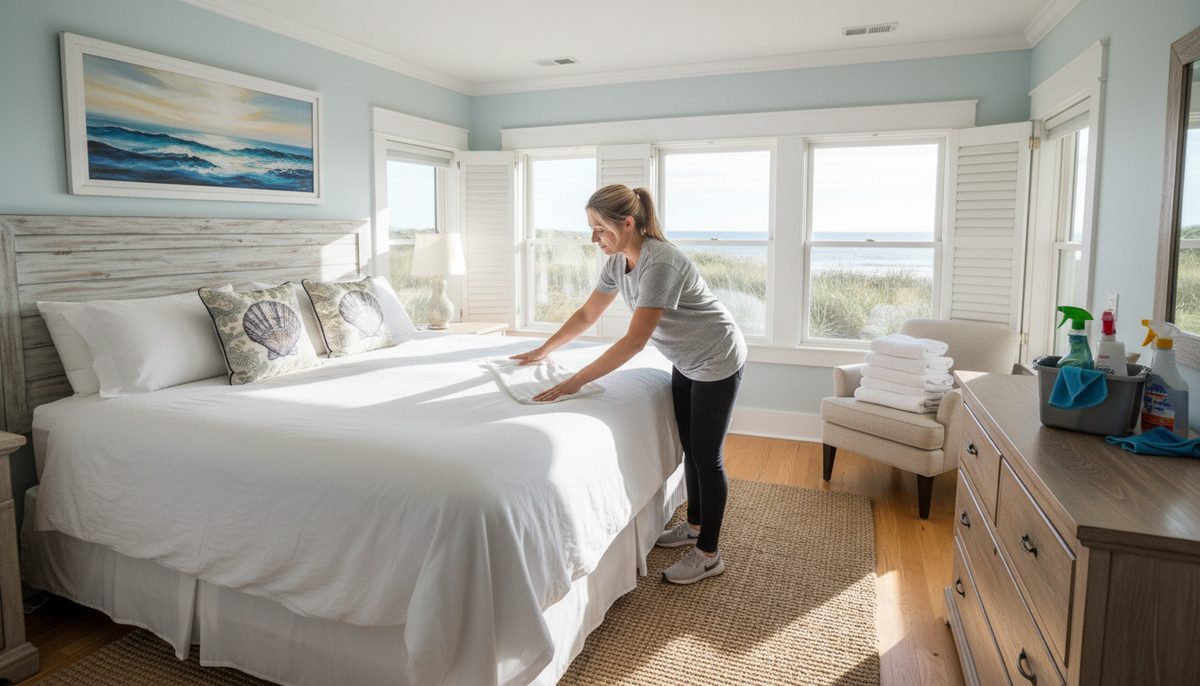
How much can a vacation rental charge for cleaning in NC?
North Carolina sets no dollar cap on vacation-rental cleaning fees — G.S. 42A-17(d) requires the fee in the agreement, reasonably calculated to real cleaning cost. What that means, plainly.
The rule is a sentence, not a price list
Most people arrive at this question holding two assumptions: that some state agency publishes a maximum cleaning fee, and that the answer is therefore a number. Neither assumption survives contact with the statute. What North Carolina actually gives a vacation-rental owner is one sentence of law, and the sentence is in some ways stricter than a cap. Under § 42A-17(d) — cleaning fee authorized, a vacation rental agreement may include a cleaning fee; the amount of the fee must be provided in the agreement; and the fee must be reasonably calculated to cover the costs of cleaning the residential property upon termination of the tenancy. Read those three clauses as a unit, because a fee that satisfies two of them and fails the third is not a lawful fee.
The clause doing the real work is the middle one: reasonable calculation. A dollar ceiling would be impossible to set fairly across a coast where one rental sleeps four and the house beside it sleeps sixteen. Reasonableness scales with the property instead — a fee is defensible exactly to the extent it tracks what cleaning that house actually costs. The sentence also quietly outlaws the two behaviors guests complain about most: the fee that appears at checkout with no prior disclosure, and the fee inflated far past any plausible cleaning cost to function as extra rent. The first fails the disclosure test; the second fails the calculation test on top of it.
Why this page will not print an Outer Banks average
You can find pages that quote an 'average turnover cost' for a rental market, and this will not be one of them, for a reason that is itself the answer to the question: no dated, authoritative source publishes per-turnover pricing for the Outer Banks. A number printed without a source is not data; it is decoration, and an owner who builds a fee schedule around it is planning around fiction. The verified numbers on this page are statutory ones — and notably, the statute names no figure either.
The substitute for a fake average is a real method: price the fee from the house. Count the bedrooms and bathrooms, decide how linens are handled, list what gets restocked, cost the deep-clean add-ons, and have the turn actually priced by a crew that has performed it. A fee built that way passes the reasonableness clause by construction, because it is calculated from cleaning cost rather than copied from a stranger's website.
What actually moves the cost of a turn
Bedrooms set the sheets; bathrooms set the hours. A house with one bathroom turns in a morning. A house with five turns with a crew, because five bathrooms is five tubs, five toilets, five mirrors and five floors, and every one of them is photographed by the next guest. Linen handling is the second driver: a linen service adds a per-turn cost and removes a laundry problem, while an on-site inventory trades the fee for a closet, two washers and a dryer that runs all day. Both arrangements are legitimate; they simply price differently, and the fee should say which one it is buying.
The third tier is scope: restocking paper goods, soaps and starter supplies; kitchen resets that go past the dishes; deep cleans scheduled between seasons; and post-storm work, which on this coast has its own season. Frequency is the quiet one — a house that turns weekly gets a crew that knows it, a standing checklist, and a better rate than a one-off scramble. And the calendar itself prices in: in July nearly the whole island checks out on Saturday morning and checks in at four, which means the supply of experienced crews is finite exactly when the demand for them is not.
The receipt the guest is reading
A cleaning fee never travels alone. It sits on the same receipt as the taxes on the stay: the 6% Dare County occupancy tax the county collects on gross receipts derived from the rental of accommodations, and the 4.75% NC general sales tax rate the state applies to the same rental. Guests read totals rather than line items, which is one more reason a surprise fee does damage beyond its dollars — it makes every number printed around it look negotiable too.
One thing this page deliberately does not assert: whether a standalone cleaning service is subject to North Carolina sales tax. The state's own directive pages could not be fetched when this page's facts were verified, and a claim nobody checked is exactly what this site refuses to publish. If you need that answer, get it from the Department of Revenue in writing rather than from any cleaning company's website — ours included.
When a fee goes wrong
The failure modes are few, and every one of them is old. A fee not in the signed agreement is a fee the guest never agreed to pay. A fee in the agreement but contradicted by the listing page is a dispute waiting for a Saturday afternoon. A fee sized like rent — far past any plausible cleaning cost — is the one the reasonableness clause was written for, and it is the one a guest can quote back at an owner with the statute behind them.
The repair is the same in each case: put the amount in the agreement before signature, keep it tied to a real, costed turn, and be able to show the arithmetic if challenged. That is not legal advice; it is the statute restated as an operating procedure, and it is how the fee on every quote we issue is built.
Tell us the bedroom and bathroom count, the linen arrangement, and how the house turns across the season — we will cost the turn and quote the fee, and the number in your agreement will be one the statute would recognize: calculated from the work, stated up front, and attached to the real cost of the clean.
On the record: § 42A-17(d) — cleaning fee authorized (N.C. General Statutes § 42A-17(d) — Accounting; Reimbursement (ncleg.gov, retrieved 2026-09-17)) · 6% Dare County occupancy tax (Dare County Tax Department — Occupancy Tax (darenc.gov, retrieved 2026-09-17)) · 4.75% NC general sales tax rate (N.C. General Statutes § 105-164.4(a) (ncleg.gov, retrieved 2026-09-17))
Hand-verified 2026-09-17 against the primary sources named above; where a fact could not be verified it was left out, never guessed.